
The Latest Breakthroughs in 3D Printing: Why the Technology Is Entering Its Most Disruptive Era Yet
For years, 3D printing was dismissed as a prototyping tool—useful, clever, but limited. Print a plastic part, test a design, move on. That narrative is officially dead.
Today’s 3D printing landscape looks nothing like its early years. The technology is evolving into intelligent, autonomous, material-agnostic manufacturing, capable of operating in extreme environments, producing end-use parts, and even correcting itself mid-print.
This isn’t incremental progress.
It’s a phase change.
Below is a deep look at the most important recent technological developments in 3D printing—and why they matter far beyond hobbyists and labs.
1. AI Is Taking Control of the Print Process
The single most important shift in modern 3D printing is this:
Printers are no longer passive machines.
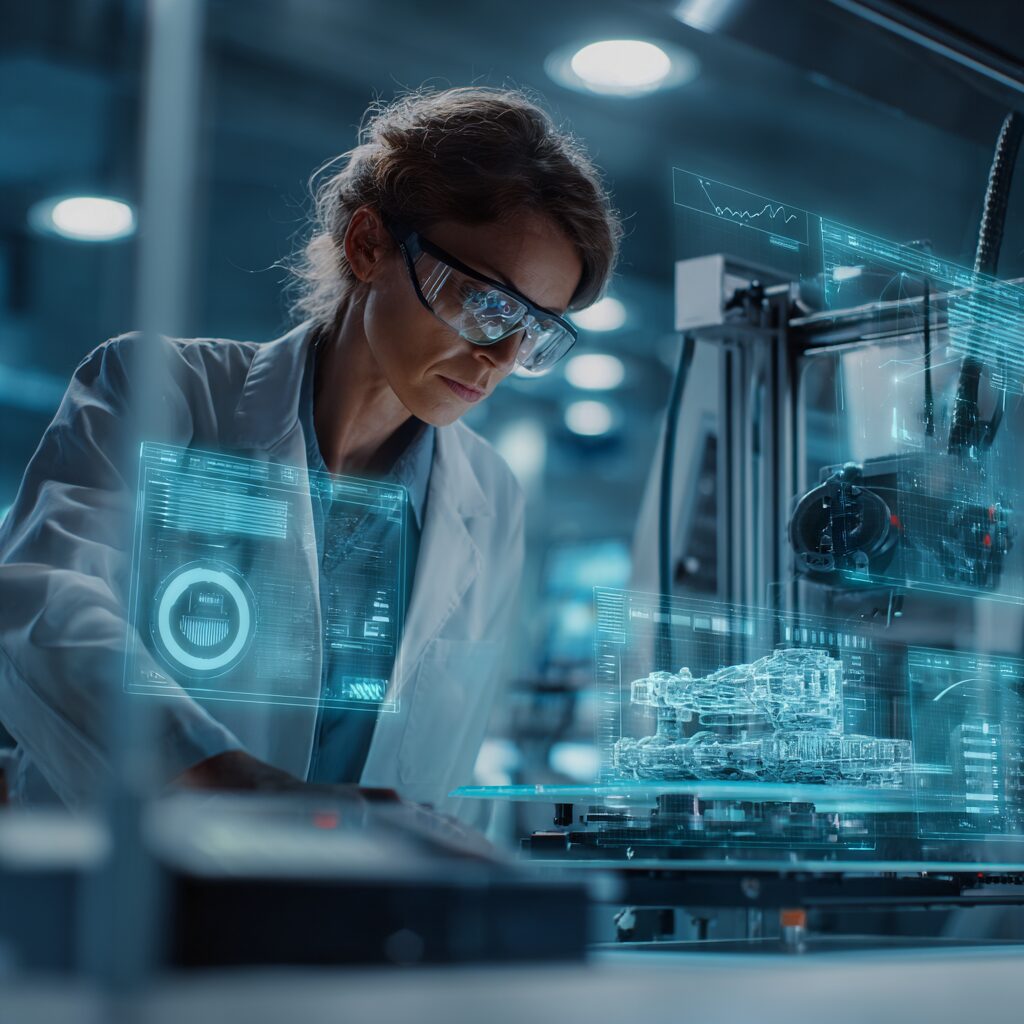
AI systems are now embedded directly into the printing workflow, enabling real-time monitoring, decision-making, and correction while a part is being fabricated.
What’s changed
-
Cameras and sensors continuously analyze each layer
-
AI detects defects such as warping, under-extrusion, layer separation, or material inconsistencies
-
Print parameters are adjusted on the fly—speed, temperature, extrusion rate, laser power
This eliminates the old “print and pray” approach.
Why it matters
-
Failure rates drop dramatically
-
Material waste is reduced
-
Human oversight becomes optional
-
Production printing becomes realistic, not experimental
This shift is turning 3D printers into autonomous manufacturing agents, not just tools.
2. Printing Materials Once Considered Impossible
Another major breakthrough is material science.
Recent advances have unlocked the ability to 3D print extreme-performance materials that were previously incompatible with additive manufacturing.
Examples include:
-
Ultra-hard tungsten-based alloys
-
High-temperature ceramics
-
Advanced composites with extreme wear resistance
-
Functional metals for aerospace and tooling
These materials were historically too brittle, too dense, or too thermally unstable to print reliably.
Why this is a big deal
-
Tooling, cutting instruments, and industrial wear parts can now be printed on demand
-
Additive manufacturing moves deeper into heavy industry
-
Machining is no longer the default for high-stress components
This marks the transition from plastic novelty to industrial necessity.
3. 3D Printing in Extreme Environments Is Now Real
One of the most surprising developments is where 3D printing is now happening.
Not just factories.
Not just labs.
New environments include:
-
Underwater construction and repair
-
Disaster zones
-
Remote military operations
-
Offshore and subsea infrastructure
-
Low-access or hazardous environments
Researchers have demonstrated the ability to print directly underwater, repairing or constructing structures without the need for dry docks or large crews.
Why this matters
-
Infrastructure repair becomes faster and cheaper
-
Human risk is reduced
-
Supply chains are shortened or eliminated entirely
3D printing is becoming a field-deployable manufacturing system, not a fixed facility.
4. Distributed and On-Demand Manufacturing Is Scaling
3D printing is quietly dismantling traditional supply chains.
Instead of:
-
Shipping spare parts
-
Stockpiling inventory
-
Waiting weeks for replacements
Organizations are increasingly printing parts at the point of need.
Where this is happening
-
Defense and aerospace
-
Medical device manufacturing
-
Remote research stations
-
Industrial maintenance operations
Why it’s transformative
-
Downtime is reduced
-
Logistics costs collapse
-
Manufacturing becomes decentralized
In practical terms, 3D printing is turning data into inventory.
5. Multi-Material and Functional Printing Is Maturing
Modern printers are no longer limited to one material at a time.
Advanced systems now support:
-
Multi-material deposition
-
Gradient materials within a single part
-
Embedded electronics
-
Flexible + rigid structures in one build
This enables:
-
Soft robotic components
-
Functional mechanical assemblies printed in one step
-
Devices with built-in conductivity, flexibility, and structure
The line between printing a part and printing a system is dissolving.
6. Volumetric and High-Speed Printing Are Breaking Old Limits
Traditional 3D printing builds parts layer by layer. That approach is slow.
New methods are emerging that:
-
Cure entire volumes at once
-
Print complex geometries in seconds instead of hours
-
Combine speed with high resolution
This fundamentally changes production economics.
When print times drop by orders of magnitude:
-
Mass customization becomes viable
-
Small-batch manufacturing beats injection molding
-
Design freedom expands dramatically
7. 3D Printing Is Becoming Production-First, Not Prototype-First
The biggest mindset shift is happening quietly.
Companies are no longer asking:
“Can we prototype this with 3D printing?”
They’re asking:
“Why aren’t we manufacturing this with 3D printing?”
Advances in:
-
Reliability
-
Repeatability
-
Quality control
-
Material strength
have pushed additive manufacturing into end-use production across multiple industries.
This includes:
-
Aerospace brackets and housings
-
Medical implants and devices
-
Industrial tooling and fixtures
-
Custom consumer products
8. Software Is Now More Important Than Hardware
The most valuable innovations in 3D printing today aren’t mechanical.
They’re digital.
Key developments include:
-
AI-generated designs
-
Simulation-first printing
-
Predictive failure analysis
-
Automated slicing optimization
-
Closed-loop manufacturing systems
Printers are becoming hardware platforms—while intelligence lives in software.
This mirrors the evolution of other industries:
-
Smartphones
-
Autonomous vehicles
-
Robotics
The future of 3D printing belongs to those who control the algorithms, not just the machines.
What This All Adds Up To
3D printing is no longer:
-
A niche technology
-
A hobbyist curiosity
-
A prototyping shortcut
It is becoming a core manufacturing paradigm.
The defining characteristics of modern 3D printing:
-
Intelligent and self-correcting
-
Capable of extreme materials
-
Operable in hostile environments
-
Decentralized and on-demand
-
Software-driven and adaptive
This is not the future arriving someday.
It’s already happening—quietly replacing old assumptions about how things are made.
Final Thought
The biggest mistake people still make about 3D printing is assuming the revolution will be loud.
It won’t be.
It will happen part by part, system by system, supply chain by supply chain—until one day, traditional manufacturing simply looks inefficient.
By then, 3D printing won’t be “the future.”
It will just be how things are made.
Leave a Reply