
3D Printing Investments: Why Defense, Not Desktop, Is Driving the Money
The short version
The 3D printing industry is a $24.2 billion business growing about 11% a year, and the growth is no longer coming from selling printers. It is coming from selling printed parts to customers who must have them made quickly, domestically and in small runs. That describes defense, aerospace and medical work far better than it describes hobby or prototype printing.
If you invest in, build for, or buy from this industry, the 2026 data points one way: money is flowing to fewer, larger, production-scale companies, and away from broad bets on machine technology.
The headline number is smaller than you think
The most cited yardstick, the Wohlers Report 2026, puts global additive manufacturing revenue at $24.2 billion in 2025, up 10.9%. Before the pandemic, growth ran above 20%. Other analyst firms publish figures from $28 billion to well over $100 billion for 2026, but they define the market more broadly and apply 17% to 24% growth rates. Treat those as forecasts, not measurements.
The split inside the Wohlers number is the real story. AM services grew 15.5% in 2025. System (printer) sales grew 3.6%.
Wohlers’ director of market intelligence, Dr. Mahdi Jamshid, put the shift this way:
“Additive manufacturing is no longer advancing on a single, uniform growth curve. What we see in Wohlers Report 2026 is an industry adjusting to tighter capital conditions, more selective investment, and higher expectations for utilization and return.”
In plain terms, companies are running the machines they already own harder and paying others to print parts, instead of buying new equipment. Wohlers also reports that defense is now the leading revenue-generating sector, followed by aerospace, medical and research.
Defense is where the volume and the money are
Three pieces of 2026 evidence point the same way.
Government demand. 3DNatives reports Department of War funding for additive manufacturing rose 83% to $3.3 billion in fiscal 2026. Named awards include a $9.8 million Defense Logistics Agency agreement with Velo3D, a $29.7 million Air Force contract for Beehive Industries, and a $31 million NAVAIR contract for Colibrium Additive.
Company results. In its second quarter, Stratasys said aerospace and defense, its largest vertical, grew 17% year on year, even as total revenue was flat at $137.6 million and system sales fell to $26.4 million. 3D Systems reported printer sales up more than 45% in the quarter and a semiconductor and high-performance-computing business growing almost 30%, driven by metal parts.
Private capital. The biggest rounds went to firms with defense-linked production:
| Company | Round | What it builds |
|---|---|---|
| Divergent | $290M Series E (Sep 2025), $2.3B valuation | Digital design, printing and automated assembly for aerospace and defense; revenue up fivefold in 2025 |
| VulcanForms | $220M Series D (Jan 2026) | Production metal printing; customer demand exceeded capacity for the first time |
| Icon | $200M Series D (Oct 14, 2026) | Robotic construction printing; U.S. Army contract for 10 barracks at Fort Bliss, valued at $62.8M |
| Impossible Objects | $40M Series B (Sep 2026) | Composite parts for aerospace and defense |
Divergent’s co-founder and CEO, Lukas Czinger, framed the use of the money plainly: “This funding enables us to scale DAPS for aerospace and defense, expand our world-class team, and strengthen America’s industrial base with a truly next-generation system.”
Fewer deals, bigger checks
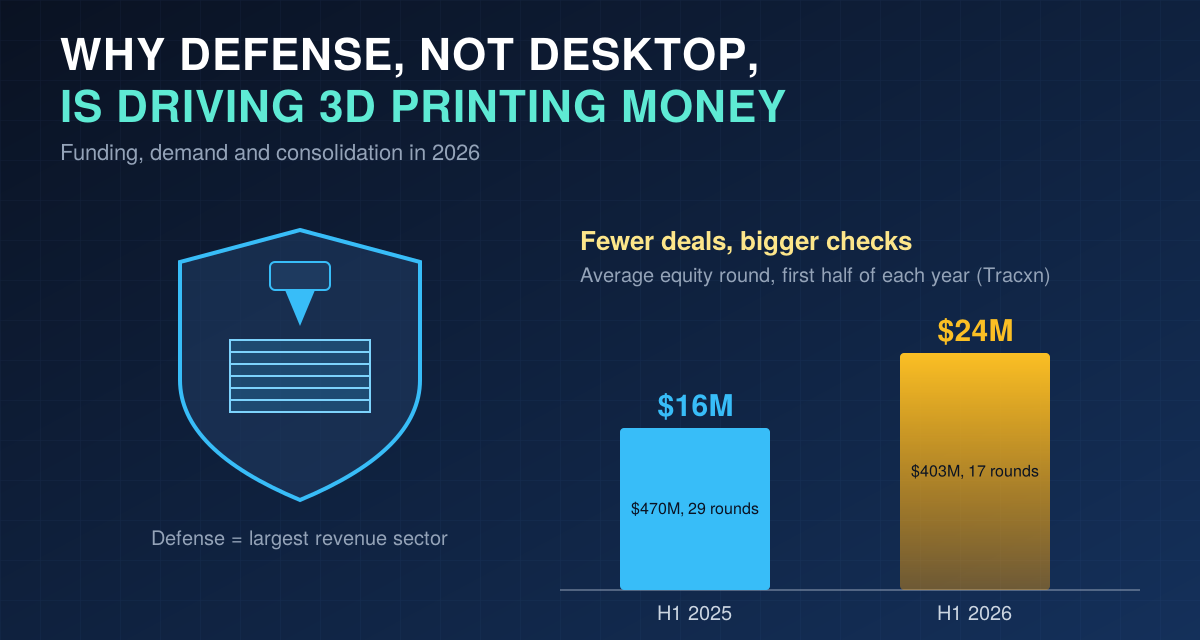
Tracxn counts $403 million across 17 equity rounds in the first half of 2026, against $470 million across 29 rounds a year earlier. That is roughly 14% less money and 41% fewer deals, so the average round grew from about $16 million to about $24 million (our arithmetic from Tracxn’s totals). 3DPrint.com describes the same pattern: investors backing fewer companies, with bigger checks, for businesses already delivering production at scale.
Specialist funds remain small. AM Ventures, the Munich venture arm of the Langer Group, closed a hard-capped fund of about EUR 100 million holding around 17 seed-stage companies. Early-stage rounds still happen, such as Radian Forge’s $2.5 million seed for large maritime and defense metal components, but the headline dollars sit with later-stage production companies.
The consolidation experiment failed
From 2023 to 2026, the industry tested the idea that buying several struggling hardware makers would create a stronger whole. It did not work.
- Nano Dimension closed its $179.3 million Desktop Metal acquisition on April 2, 2025, after a Delaware court compelled it to complete the deal, according to AM Insight Asia.
- Desktop Metal filed for Chapter 11 on July 28, 2025, 117 days after the deal closed. Nano booked $139.4 million of impairment losses for 2025.
- In May 2026, Nano agreed to sell Markforged to Stratasys for $42.5 million in cash, keeping its Metal Binder Jetting line. It had bought Markforged for about $116 million, and 3D Printing Industry notes Markforged generated roughly $70 million of revenue in 2025.
The lesson for investors: scale built by assembling unrelated technologies destroyed value, while scale built by filling real production orders attracted it.
Desktop is not dead, but it is a different business
Consumer and prosumer printing is now a scale-and-price game led by Chinese makers. Creality listed in Hong Kong on May 29, 2026, becoming the first consumer 3D printing company on the HKEX main board, and Anycubic’s parent closed a Series B of hundreds of millions of yuan. DEVELOP3D’s view is that Stratasys and Markforged lost ground to Chinese competitors while the Nano Dimension fight played out.
The opportunity for small operators has shifted from selling machines to running them. 3DPrint.com’s January 2026 editorial described print farms of hundreds or thousands of desktop printers making products for brands, dental labs and orthotics, and its author predicted they could become a significant slice of the market. For a practical look at that path, see our guide to starting a 3D printing business in 2026 [link when published].
What this means
- If you buy printed parts: expect service providers to have more capacity and better-capitalized suppliers, especially in metal and for defense work.
- If you invest: look for demonstrated production demand and capacity constraints, not technology breadth. Be skeptical of roll-ups.
- If you build: pick a customer who needs parts that are domestic, fast and low-volume, and sell the part, not the printer.
- If you run a small shop: service growth (15.5%) is the strongest signal in the Wohlers data. Utilization is the metric investors and customers now ask about.
The next checks are Stratasys’ second-half system sales, whether VulcanForms, Divergent and Icon turn fresh capital into shipped volume, and Nano Dimension’s next move after its strategic review.
Keep reading
- 3D Printing Ventures: news and analysis on 3D printing, AI and manufacturing investment, including its 3D printing trends post.
- Bioprinting World: bioprinting, regenerative medicine and the deep tech behind them. Start with Bioprinting Stocks and Companies to Watch.
- 3D Printing Central: more 3D printing resources.
This article is analysis, not investment advice. Figures are from the sources linked above; analyst market-size forecasts vary widely by definition.
Sources
Wohlers Associates press release · 3DNatives on Wohlers · 3DNatives on U.S. defense AM · Stratasys Q2 2026 · 3D Systems Q2 2026 · Tracxn · Built In on Divergent · 3DPrint.com on VulcanForms · Construction Dive on Icon · Castle Placement, September 2026 · AM Insight Asia · I-Connect007 · 3D Printing Industry · AMPulse Asia · DEVELOP3D · 3DPrint.com on print farms · AM Chronicle on AM Ventures
Leave a Reply